|
|
|
Making a Beeline for the Nectar: How Patterns On Flowers Help Bees Spot Their First Nectar-Rich Flower
|
|
|
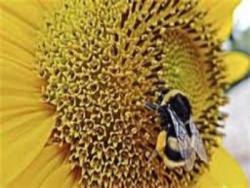
Bumblebees searching for nectar go for signposts on flowers rather than the bull's eye. A new study, by Levente Orbán and Catherine Plowright from the University of Ottawa in Canada, shows that the markings at the center of a flower are not as important as the markings that will direct the bees to the center.
|
The work is published online in Springer's journal, Naturwissenschaften -- The Science of Nature.
The first time bees go out looking for nectar, which visual stimuli do they use to identify that first flower that will provide them with the reward they are looking for? Orbán and Plowright test the relative influence of the type of floral pattern versus pattern position in a group of bumblebees that have never searched for nectar before i.e. flower-naive bees.
In a series of two experiments using both radio-frequency identification technology and video recordings, the researchers exposed a total of over 500 flower-naive bees to two types of patterns on artificial clay flowers: concentric versus radial. Concentric patterns are composed of circles or rings with the same center. Radial patterns are composed of distinctly colored lines extending from the outside of the flower, converging at the center where nectar and pollen are usually found. The patterns tested were in one of two positions on the artificial flowers: either central or peripheral, on the corolla (or petals) of the flower.
They found that both visual properties had significant effects on flower choice. However, when pitted against each other, pattern type trumped position. Bees preferred radial patterns over concentric patterns. When the influence of radial patterns in the center was compared with the influence of radial patterns on the periphery, there was little difference in the bees' response. It appears that the visual cues from the radial pattern guide the bees to the periphery of the flower. Once there, they will find the rewarding nectar in the center of the flower.
The researchers conclude: "Which came first: the chicken or the egg? The behavior of bees has been shaped over the course of evolution as adaptations to flower appearance. Equally, floral appearance has evolved in ways that cater towards bees' visual and olfactory abilities. Flowers may be taking advantage of a principle that will be familiar to students and teachers alike: the bees need not be shown the food itself, but rather, how to find it."
|
http://www.sciencedaily.com (nnhanh)
|