» Today: 04/05/2026
Technology
Lao Cai Province has officially begun construction of the EcoSapa O Quy Ho Tea Hill Ecological Urban Area, a major 2.4 trillion VND development that signals Sa Pa’s continued transformation into a high-value mountain tourism and integrated urban destination. Located in Sa Pa Ward and spanning approximately 29.3 hectares, the project represents far more than a real estate investment—it reflects a broader strategic effort to redefine highland urbanization through ecological branding, tourism infrastructure, and long-term economic diversification.
As climate change intensifies sea-level rise, erratic hydrological cycles, and saltwater intrusion across Vietnam’s coastal zones, the Red River Delta is emerging as a new frontline in the battle for agricultural resilience. Traditionally, salinity intrusion has been more strongly associated with the Mekong Delta, but growing environmental instability now increasingly threatens northern coastal farming systems as well. In response, a groundbreaking partnership between the VinFuture Foundation and the University of Science under Vietnam National University, Hanoi is launching an advanced multi-technology project designed to create a “digital shield” against salinity intrusion—an ambitious fusion of artificial intelligence, physical modeling, IoT, remote sensing, and geospatial systems aimed at protecting green agriculture and strengthening climate adaptation.
As climate change, ocean acidification, biodiversity decline, and marine pollution increasingly reshape coastal systems worldwide, Vietnam and France are deepening scientific cooperation through one of the most ambitious bilateral marine research efforts in recent years. The Plume program—an international collaboration between the Vietnam Academy of Science and Technology and France’s Institute of Research for Development (IRD)—is emerging as a major milestone in oceanographic science, environmental monitoring, and strategic knowledge-building for the future of Vietnam’s coastal resilience. More than a scientific expedition, Plume represents a powerful model of how international research partnerships can generate practical solutions to some of the planet’s most urgent ecological challenges.
Nghe An Province is entering one of its most dangerous forest fire periods in recent years, as prolonged heatwaves, dry conditions, and strong southwest foehn winds sharply elevate wildfire risks across vast areas of central Vietnam. Provincial authorities have now issued warnings ranging from dangerous (Level IV) to extremely dangerous (Level V) across more than 120 communes and wards, signaling an urgent need for full-scale prevention, preparedness, and public vigilance. The warning reflects not only a seasonal fire threat, but also a broader climate reality: forest protection in Vietnam is becoming increasingly complex as hotter temperatures and extreme weather intensify landscape vulnerability.
Dong Nai Province is intensifying forest fire prevention measures after two recent fires exposed the growing vulnerability of one of southern Vietnam’s most important ecological regions during peak dry-season conditions. As extreme heat, prolonged drought, and human-caused ignition risks converge, provincial authorities are moving urgently to prevent further damage to a forest system widely regarded as a critical environmental shield for the rapidly industrializing Southeast region. The situation highlights a broader reality facing Vietnam: in an era of rising climate volatility, forest fire prevention is becoming an increasingly strategic issue tied not only to biodiversity, but also to air quality, regional climate stability, and socio-economic resilience.
Vietnam’s construction and building materials sector is entering a decisive transformation as climate commitments, legal mandates, and global market pressures increasingly demand lower-carbon development. Traditionally viewed primarily as an engine of infrastructure and economic expansion, the sector is now being forced to confront a critical environmental reality: construction and building materials production are among the country’s largest contributors to greenhouse gas emissions. As Vietnam advances toward greener growth targets, reducing emissions in this sector is no longer optional—it is becoming central to national climate resilience, industrial competitiveness, and long-term economic modernization.
As climate pressures intensify across Vietnam, the Ministry of Agriculture and Environment is urging provinces in the Central region, Central Highlands, and Mekong Delta to rapidly implement stronger drought and salinity prevention measures to protect agricultural production. With the 2026 summer-autumn crop season approaching, water scarcity and saltwater intrusion are emerging once again as major threats to food security, rural livelihoods, and long-term climate resilience. Recent assessments indicate that approximately 10,700 to 16,400 hectares of crops in Central Vietnam and the Central Highlands may face significant risk from drought and salinity if preventive action is not taken quickly.
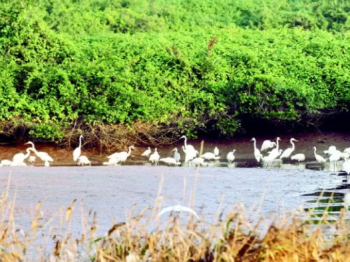
At Ba Lat estuary in Ninh Binh Province, where the Red River meets the East Sea, Xuan Thuy National Park unfolds as one of Vietnam’s most remarkable ecological treasures. In the early morning, as the tide recedes, fertile mudflats gradually emerge beneath golden sunlight, revealing a landscape constantly shaped by water, sediment, and time. This serene coastal region is far more than a scenic wetland—it is a living system where mangrove forests, migratory birds, and local communities coexist in a delicate balance. Today, Xuan Thuy stands at the center of an important national conversation about conservation, green growth, and sustainable coastal development.
Vietnam’s mineral resources remain a vital foundation for national development, particularly as demand for construction materials continues to rise alongside major infrastructure expansion. From transportation networks to urban development, minerals such as sand, stone, and other building materials are essential to economic progress. However, maximizing this strategic resource requires more than extraction alone—it demands a careful balance between economic efficiency, transparent governance, and environmental sustainability. Recent reforms in Vietnam’s geological and mineral laws are creating important opportunities to improve resource management, but long-term success will depend on implementation, oversight, and responsible exploitation.
As part of the vibrant “Sac Sua Huong Tra – Da Nang 2026” Festival, Huong Tra Ward in Da Nang officially inaugurated the innovative “Listening Station Where Birds Tell Stories” on April 26, introducing a remarkable blend of nature, technology, art, and community engagement. More than just a cultural attraction, this project represents a creative environmental initiative designed to deepen public appreciation for biodiversity while fostering sustainable conservation awareness, especially among younger generations.
Previous 1 2 3 4 5 [6] 7 8 9 10 Next
Top
© Copyright 2010, Information and Documentation Center under Can Tho Science and Technology Department
Address: 118/3 Tran Phu street, Cai Khe ward, Ninh Kieu district, Can Tho city Tel: 0710 3824031 - Fax: 0710 3812352 Email: tttlcantho@cantho.gov.vn License No. 200/GP-TTÐT dated November 11st, 2011 by Agency for Radio, Television and Electronic Information under Minister of Information and Communication