Agriculture - Forestry - Fishery
|
|
Herbal extract resists anthracnose fungus on chili plants
|
|
|
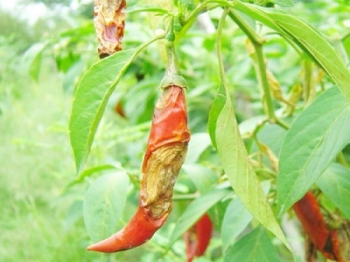
According to new research from the University of Agriculture and Forestry and the Open University of Ho Chi Minh City, extracts from ginger and the plant have shown the ability to inhibit the fungus that causes anthracnose on chili plants by up to 94%.
|
Chili is not only an important spice but also has high economic value in Vietnam. However, chili plants are often affected by a variety of fungal, bacterial and insect diseases, of which anthracnose caused by the fungus Colletotrichum is the most serious, which can reduce yields by 10% to 80%. This disease infects from the seedling stage to the ripe fruit, affecting the commercial value and quality, and reducing the content of capsaicin and oleoresin, the two main components that give chili its spicy taste.
The research team collected chili pepper samples (chili pepper and African yellow pepper) with disease symptoms from gardens in Tien Giang. The symptoms of the disease are gray-brown to black-brown lesions with mucus, and when severe, tiny black branch discs appear. The results showed that the group isolated 30 samples of Colletotrichum spp., of which two species of fungi causing anthracnose on pepper were identified, Colletotrichum scovillei and Colletotrichum gloeosporioides. Based on the pathogenicity test, the infection rate reached 50% without wounding, but up to 100% when there was a wound on the fruit.
To evaluate the ability to inhibit fungi, the research team extracted ginger and leaves of the plant and tested them at different concentrations. The results showed that both ginger and plant extracts had good antifungal effects. Specifically, the optimal concentration to achieve maximum inhibitory effect was 10% ginger, 11% maggot and 10% mixture; in addition, using 8% ginger extract and 9% maggot gave inhibitory effect on fungal spores of 94.1% and 82.5% respectively after 24 hours. This study not only confirmed the effectiveness of herbal extracts in controlling anthracnose but also opened up prospects for replacing chemical fungicides. The results of this study were published in Can Tho University Journal of Science, No. 1/2025.
|
nhahuy
Follow www.cesti.gov.vn |